
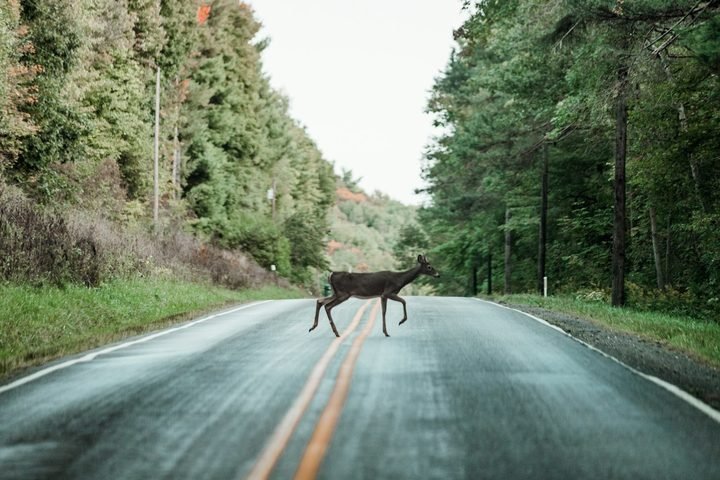
In 30 seconds
- Damage from hitting an animal is covered by comprehensive coverage, which is optional.
- If you only carry liability, or liability and collision, your insurer won't pay to fix your vehicle after hitting a deer, the NAIC says.
- You still pay your deductible, and the insurer pays up to your policy limits.
- If a crash can't be avoided, brake firmly and try not to swerve.
In this article
By the numbers
- About 1.5 million deer-related crashes a year
- More than $1 billion in insured losses a year
- Peak months: October and November
- Riskiest times: dawn and dusk
Figures as reported by the NAIC, citing federal highway safety data.
Which coverage pays when you hit a deer
This surprises many drivers: hitting a deer is not a collision claim. The NAIC says damage from a collision with an animal is covered under an auto policy's comprehensive coverage.
| Your coverage | Pays to fix your vehicle after hitting a deer? |
|---|---|
| Liability only | No |
| Liability and collision | No |
| Comprehensive (with or without collision) | Yes, minus your deductible, up to your policy limits |
Source: NAIC.
If you're not sure what you carry, check your policy's declarations page or your insurer's app before you need it.
If a deer runs out in front of you
- Hold the wheel firmly. Keep both hands on the wheel.
- Brake to a stop. Brake firmly and in a controlled way.
- Try not to swerve. The NAIC advises against swerving if you can't avoid the collision. Swerving can send you into oncoming traffic, a ditch or a tree.
What to do right after you hit a deer
- Stay calm and get safe. If you can, move to a safe spot and turn on your hazard lights.
- Call for help if needed. Alert the authorities if you can't move your vehicle or the animal is blocking traffic. Call 911 if anyone is hurt.
- Take photos. Photograph the vehicle damage, the road and any injuries.
- Check your vehicle before driving. Look for leaking fluid, broken lights and loose parts. If you're unsure it's safe, call a tow truck.
- Call your insurer. Report the claim and ask how your deductible applies.
An injured deer can kick and hurt you. Stay away from it and let authorities handle it.
How the claim works: a worked example
Mark's November commute
Mark hits a deer on a rural road at dusk. The repair estimate is $3,000. He has comprehensive coverage with a $500 deductible.
He pays the first $500, and his insurer pays the remaining $2,500, up to his policy limits.
His neighbor had the same kind of crash but carried only liability and collision. Her insurer doesn't pay to repair her vehicle, so the full bill is hers.
Illustrative example. Names and numbers are made up to show how it works.
That gap is why comprehensive coverage matters most if you drive where deer are common, or if your vehicle would be expensive to repair. If you have a loan or lease, your lender usually requires it anyway.
How to lower your risk this season
- ✓ Slow down near deer-crossing signs.
- ✓ Be extra careful at dawn and dusk, when animals are most active.
- ✓ If you see one deer, expect more. They often travel in groups.
- ✓ Keep your headlights working and use high beams when no one is coming the other way.
- ✓ Put the phone away, and always wear your seat belt.
Rutting, or mating, season for deer runs from roughly October through December, which is why the risk climbs in the fall.
Frequently asked questions
Does auto insurance cover hitting a deer?
Yes, if you have comprehensive coverage. The NAIC says liability or collision alone won't pay to repair your vehicle after hitting an animal.
Is hitting a deer a collision or comprehensive claim?
Comprehensive. Damage from hitting an animal is covered under the comprehensive part of an auto policy.
Do I pay a deductible if I hit a deer?
Yes. Your comprehensive deductible applies, and the insurer pays the rest up to your policy limits.
Should I swerve to avoid a deer?
The NAIC advises holding the wheel firmly, braking to a stop and trying not to swerve if a collision can't be avoided.
When are deer crashes most common?
October and November see more deer crashes than the rest of the year, especially around dawn and dusk.
See what you could pay
Compare options available where you live, or call to talk it through with a licensed agent. Looking is free.
ConnectingCrowd is an information site and is not affiliated with any government agency.
Compare auto insurance options
SponsoredRelated guides
See all auto insurance guides Comprehensive vs collision coverage: which one pays for what
 Just had an accident? How to file an auto insurance claim, step by step
 Picking an auto insurance deductible you can actually afford
 Vehicle stolen? The steps to take with police and your auto insurance
 Buying a used car? How to spot hidden flood damage first
 Personal injury protection (PIP): how no-fault auto insurance pays after a crash
See auto insurance options near you
Rates and available coverages vary by state and insurer. Add your ZIP code to compare. It is free and you are not committing to anything.
Find auto insurance that fits your loan or lease
SponsoredDisclaimer: This article is for general information only and is based on publicly available sources, which may be incomplete, outdated or incorrect. It is not legal, financial, insurance, tax or medical advice. ConnectingCrowd is not affiliated with any government agency, insurer or lender. Please do your own research and talk to a licensed professional before making any decision.