
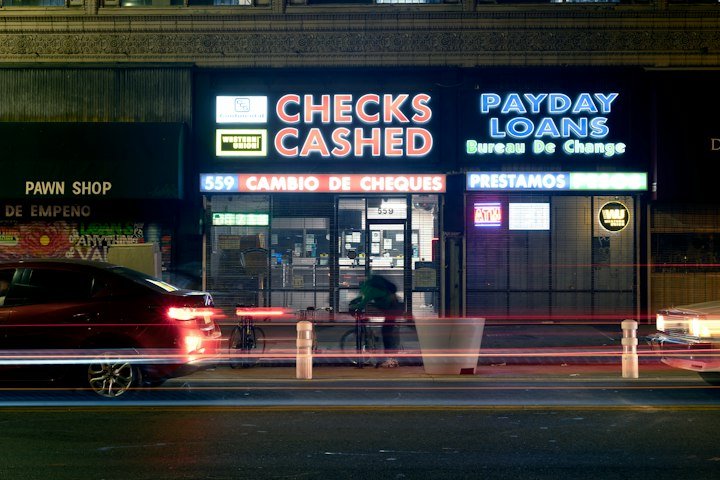
Payday vs personal loans in four points
- Payday loans are usually $500 or less and typically due on your next payday, the CFPB says.
- Fees often range from $10 to $30 per $100 borrowed. $15 per $100 for two weeks is an APR of almost 400%.
- Rolling a payday loan over adds a new fee, and you still owe the original amount.
- Federal credit unions may offer payday alternative loans, which the FTC says cost much less.
In this article
Payday loan numbers
- $500 or lessTypical payday loan size
- $10 to $30Fee per $100 borrowed, depending on state law
- ~400%APR of a two-week loan at $15 per $100
- 36%Rate cap for active-duty servicemembers under the Military Lending Act
From the CFPB and the FTC.
How a payday loan works
The CFPB describes a payday loan as a short-term, high-cost loan, generally for $500 or less, that is typically due on your next payday. You usually give the lender a post-dated check or permission to withdraw the money from your bank account. If you don't repay on time, the lender can cash the check or take the money electronically. The CFPB also notes that payday lenders generally don't check whether you can afford to repay while covering your other bills.
What it really costs
The CFPB says payday fees can range from $10 to $30 for every $100 borrowed, depending on your state, and $15 per $100 is common. On a two-week loan, that equals an APR of almost 400%. Borrow $300 and you would repay $345.
If you can't pay, some states let you roll the loan over by paying only the fee. The CFPB says you are then charged another fee and still owe the full original balance. In its example, two weeks of extra time on that $300 loan means $90 in fees for four weeks of borrowing.
Payday loan vs personal loan
| Feature | Payday loan | Personal loan |
|---|---|---|
| Typical size | $500 or less | Usually larger |
| Repayment | Often one payment on your next payday | Monthly installments over months or years |
| Cost | Fees that can equal an APR near 400% | Interest shown as an APR you can compare across lenders |
| Credit history | The CFPB says on-time payments don't help your credit | On-time payments may help build credit if the lender reports them |
Payday figures from the CFPB. Personal loan terms vary by lender and your credit. Compare the APR on any loan offer.
Lower-cost options to try first
- Ask your creditors for more time. The FTC suggests asking for an extension, and checking for any late or finance charges.
- Check a credit union. Federal credit unions may offer payday alternative loans, which the FTC says are much less expensive.
- Ask your bank. The FTC notes some large banks offer small loans of up to $1,000, including to customers with low or no credit scores.
- Get free help. Nonprofit credit counseling, local charities and churches may be able to help. See our guide to credit counseling.
If you serve in the military
The Military Lending Act caps the Military Annual Percentage Rate at 36% on many types of credit for active-duty servicemembers and their dependents, including payday loans, the FTC says. Military OneSource offers free financial counseling at 1-800-342-9647.
Watch out for look-alikes
Car title loans work in a similar way but use your vehicle as collateral. The FTC says monthly fees can reach 25%, about 300% APR, and the lender may repossess your vehicle even if you have made partial payments. Before you take any loan, read our guides to APR vs interest rate and personal loan scams.
Frequently asked questions
How much does a payday loan cost?
The CFPB says fees often range from $10 to $30 per $100 borrowed. A common $15 per $100 fee on a two-week loan equals an APR of almost 400%.
Is a personal loan better than a payday loan?
Personal loans are repaid in monthly installments, and the cost is shown as an APR you can compare. The FTC says credit union payday alternative loans are much less expensive than payday loans.
Do payday loans help my credit?
The CFPB says that even if you make on-time payments, a payday loan does not help your credit history.
What is a payday alternative loan?
A small loan offered by some federal credit unions. The FTC says these are much less expensive than payday or car title loans.
Compare loan options for your situation
Compare options available where you live, or call to talk it through with a licensed agent. Looking is free.
ConnectingCrowd is an information site and is not affiliated with any government agency.
Compare personal loan options
SponsoredKeep reading



Keep exploring personal loans
- Credit Builder Loans: How They Work and Who They Help
- Personal Loan Prepayment Penalty: Can You Pay Off Early?
- Buy Now, Pay Later vs a Personal Loan: Key Differences
- APR vs Interest Rate: Which Shows the Real Loan Cost?
- Debt-to-Income Ratio: How to Calculate DTI and Lower It
- Personal Loan Cosigner: Risks and Rules Before You Sign
- Personal Loan vs HELOC: Which Is Better for Your Project?
- Personal Loan Requirements: What Lenders Check First
- Personal Loan Origination Fees: The Real Cost Explained
Other topics:MedicareAuto insuranceLife insuranceHome insuranceDebt reliefAll guides
See loan options in your state
Loan rules and rates vary by state and lender. Enter your ZIP code to compare options. Looking is free.
Compare loan options for your situation
SponsoredSources
Disclaimer: Connecting Crowd is an independent information website. We do not represent any insurance company, lender, agency or government body. Everything on this site is for general information only. Details such as prices, rates and rules can change and may differ slightly from what is shown here, so please do your own research and verify any information with the official source or a qualified professional before making a decision. This page contains advertising, and we may be paid when you click a link or call a number.